
Our FurnitureAbout AKAFUJIRYUICHI Furniture: Points to Note Before Purchasing
Most of the furniture handled by AKAFUJIRYUICHI is antique furniture made in Japan from several decades to over a hundred years ago. We acquire old Japanese furniture that has been carefully used for a long time, meticulously restore it to breathe new life into it, and pass it on to the future.

Our workshop is staffed by furniture professionals with experience in furniture manufacturing at woodworking shops, repairing American and European vintage furniture, and purchasing and sales at interior shops.
We have been captivated by old Japanese furniture after working with various types of furniture, both domestic and international, new and old.
It is packed with so much charm, such as beautiful wood grain, the beautiful texture deepened over time, and the character of handmade craftsmanship.
While thinking about the long history that each piece of furniture has experienced, we always strive to finish them in a way that maximizes their charm.
While showing respect for the work of the craftsmen of that time and being grateful that the furniture still exists safely today, we add our own workshop's expression to finish it as a one-of-a-kind piece.
A one-of-a-kind piece of furniture reborn with a new brilliance.
It is our greatest joy to deliver it to you and to have you cherish it for years to come.
Repair Policy
Scratches and stains that have accumulated over many years on antique furniture are unintended traces of people's lives. The deep, characterful look created by these scratches and stains is a personality unique to that piece of furniture.

It is possible to restore furniture beautifully by refinishing the surface or replacing parts with new materials. In the extreme, it is not impossible to make furniture of the same shape using all new materials.
However, if we work on it more than necessary, the charm of the antique furniture that we want to convey will be lost.
It is very difficult to decide how much to work on and what to leave while making the most of the antique furniture's charm.
The condition of antique furniture varies depending on the environment and how it was used; no two pieces are the same, and all are one-of-a-kind. At our workshop, we face each piece of furniture firmly every time, determine its condition and personality, and consider the direction of the finish before starting restoration.
Depending on each condition, we decide the best restoration method while balancing the preservation of the antique character with usability and price.
Also, on the premise of utilizing the charm of antique furniture, we are always exploring new possibilities by incorporating combinations with modern materials and processing and finishing methods not generally used for Japanese furniture.
Antique Furniture Finishing
Furniture that has aged over many years has several differences from modern, new furniture.
Scratches, Stains, Rust, Chips, etc.
Because the furniture was made from several decades to over a hundred years ago, basically all of it has fine scratches, stains, rust, or chips.


The degree and appearance of scratches, etc., differ depending on the original condition and the finishing method.
For parts that significantly detract from the appearance or cause problems in use, we perform repairs such as partially replacing them with new materials or applying a new coat of paint. Since each piece is in a different condition, please check the photos on each product detail page.
Interior Finishing
The insides of doors and drawers are restored using the methods below, depending on the condition of the antique furniture and the direction of the finish. Please check the individual product detail page to see what kind of restoration has been done to each piece of furniture.
・Polished Finish
Finished by polishing the surface while keeping the original material.
Deep scratches and stains may not be removed, but you can enjoy the original texture of the material.


・Painted Finish
After polishing and tidying the surface while keeping the original material, we finish it with paint, sometimes adding color depending on the desired image of the painted finish.


・Re-lining
If the damage is too great to be handled by polishing, or if you want to refresh the interior, we replace it with new materials such as plywood boards like shina (linden) or paulownia. While it is no longer the original material, it is a finish that is easy to use even for those who are new to antique furniture.

Characteristics of Solid Wood
Many of the furniture pieces handled by our workshop are made of solid wood.
Solid wood is a material made from wood cut directly from a log.
In modern times, due to technological development, materials such as printed plywood with wood grain, polyester plywood, and melamine decorative boards have become widely used.
Compared to these new materials, natural solid wood has a rich appearance and is characterized by the fact that it deepens in color with age and gains an attractive texture.
Also, because it is a living material that breathes, it is constantly expanding and contracting depending on the environment such as humidity. While the rich expression and texture of furniture made from such solid wood are attractive, it also has the characteristic of "movement" such as cracking, warping, and twisting.

The photo shows a drawer of an antique tansu before repair.
This era's tansu chests were all made of solid wood, and the bottom board of the drawer is also made of joined solid wood boards. Over a long period of time, the boards have shrunk and gaps have formed, but this is a common condition seen in old furniture such as antique tansu.

This is the photo after repair. Such gaps are repaired by embedding new wood in that part, depending on the situation.
Even after restoration, solid wood continues to expand and contract, and there is a possibility that cracks may form again. Please understand in advance that this is unavoidable due to the characteristics of solid wood.

Also, depending on the condition, we may replace the solid wood with shina plywood or the like. In the case of such plywood finishing, cracks will not occur.
*When using a finish that retains the original atmosphere, we may leave the cracks as they are, considering the overall balance of strength, usability, and price.
Furniture Dimensions and Distortion
Many advanced machine tools have been introduced in the production sites of modern new furniture, and purely handmade pieces are becoming very rare. While the history of handmade work has decreased with the development of machine tools, going back to the time when antique tansu chests were made, the wooden parts and even the metal fittings were all handmade. In addition to that, due to the "movement" of solid wood over many years, the dimensions of the furniture almost always have an error of several millimeters depending on where you measure. The width × depth × height dimensions listed on each product detail page reflect the largest part amidst those errors.

Also, for the same reason as above, there are often warps, distortions, gaps, and cracks in the members.
Depending on the degree, we perform repairs such as manufacturing and replacing members if necessary, but due to the nature of handmade, solid wood, sometimes there are things that cannot be fixed completely.
Even in that case, we only sell items that we have confirmed to have no problems in terms of structure, strength, and usage.
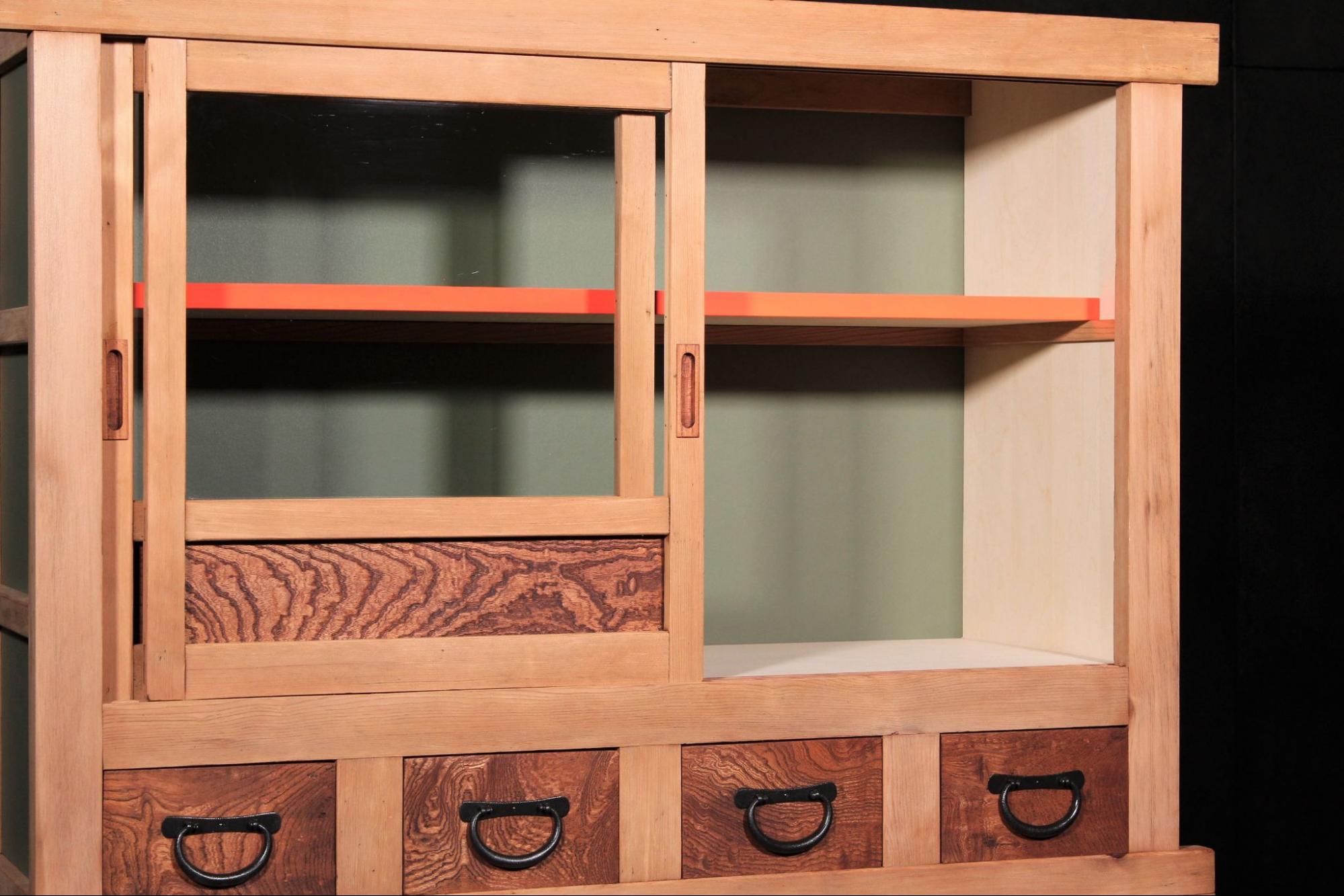
The tea cabinet in the photo above shows a slight warp in the square timber on the top of the door. Also, cracks can be seen on the end grain of the same square timber. In this case, it was judged that there were no problems with strength or usage as it is, and the condition would not worsen, so we have finished it in this state.
It is not impossible to manufacture and replace new parts with the same dimensions, but in that case, the old atmosphere and tasteful texture would be lost. Considering such a balance, we carefully select the parts to be repaired and those that are not.
Glass
Regarding furniture that uses glass, from the perspective of inheriting the original atmosphere and cherishing the materials, we try to use the glass from the time as it is as much as possible. For small scratches, if they are mild, we only perform cleaning.


If there are cracks or conspicuous large scratches, we will replace them, but even then, we cut and reuse old glass we have in stock, so there may be small scratches. We sometimes replace it by manufacturing new glass, but only when the dimensions or number of pieces cannot be met with the stock we have.
Unpainted Finish
Some of our furniture is finished by polishing the old paint and leaving it as is.


This is an unpainted finish where the surface is adjusted after peeling off old and deteriorated paint, and it is a finishing method where you can enjoy the natural wood grain, texture, and the withered texture of antique furniture.
On the other hand, since the surface is not protected by paint, it has the disadvantage of being susceptible to stains and dirt. Because it is weak against moisture and dirt, please be careful when using it.
Adjustment of Drawers and Doors
In our workshop, we check and adjust the movement of all doors and drawers of antique furniture.


If moving parts such as drawers, hinged doors, or sliding doors are stiff, we carefully adjust them by planing them so they move smoothly. Although they look old, we finish them carefully so as not to impair their daily ease of use.
Odors
Wooden furniture may have an odor, and the following can be considered as causes:
1. Odor of materials such as cedar, paulownia, zelkova, or shina plywood
2. Odor of paint such as water-based paint, lacquer, or urethane
3. Odor of adhesive
1 is the smell of the material itself.
2 and 3 are the paints used to finish the furniture and the glue used for repairs and remakes.
The ones used in our workshop have an odor during work and drying, but it becomes almost unnoticeable once it is completely dry.
If doors and drawers are kept closed for a long time, you may notice an odor when you open them, but if you open them periodically to prevent moisture from accumulating inside, the odor will also fade.
If you are still concerned, keeping the doors and drawers open and blowing air with a fan or circulator for a while will further alleviate it. At that time, please do not forget to ventilate the room where the furniture is placed.
1 to 3 are usually within an acceptable range that does not bother you during normal use, but other than that, depending on the environment where it was previously used or stored, a strong odor may be ingrained inside the drawer, etc. In that case, the causes are as follows:
4. Insect repellent (camphor)
5. Mold
6. Stored items with strong odors (incense, perfume, etc.)
7. Smell of the room where it was previously placed (tobacco, pets, etc.)
Furniture with strong odors like 4 to 7 is difficult to deodorize, so our workshop basically does not purchase them, but we may purchase them if they seem manageable with restoration.
In that case, we remove the parts that have the odor and replace them with new materials. The tansu in the photo below is one where the drawer bottom board has been newly replaced with shina plywood.
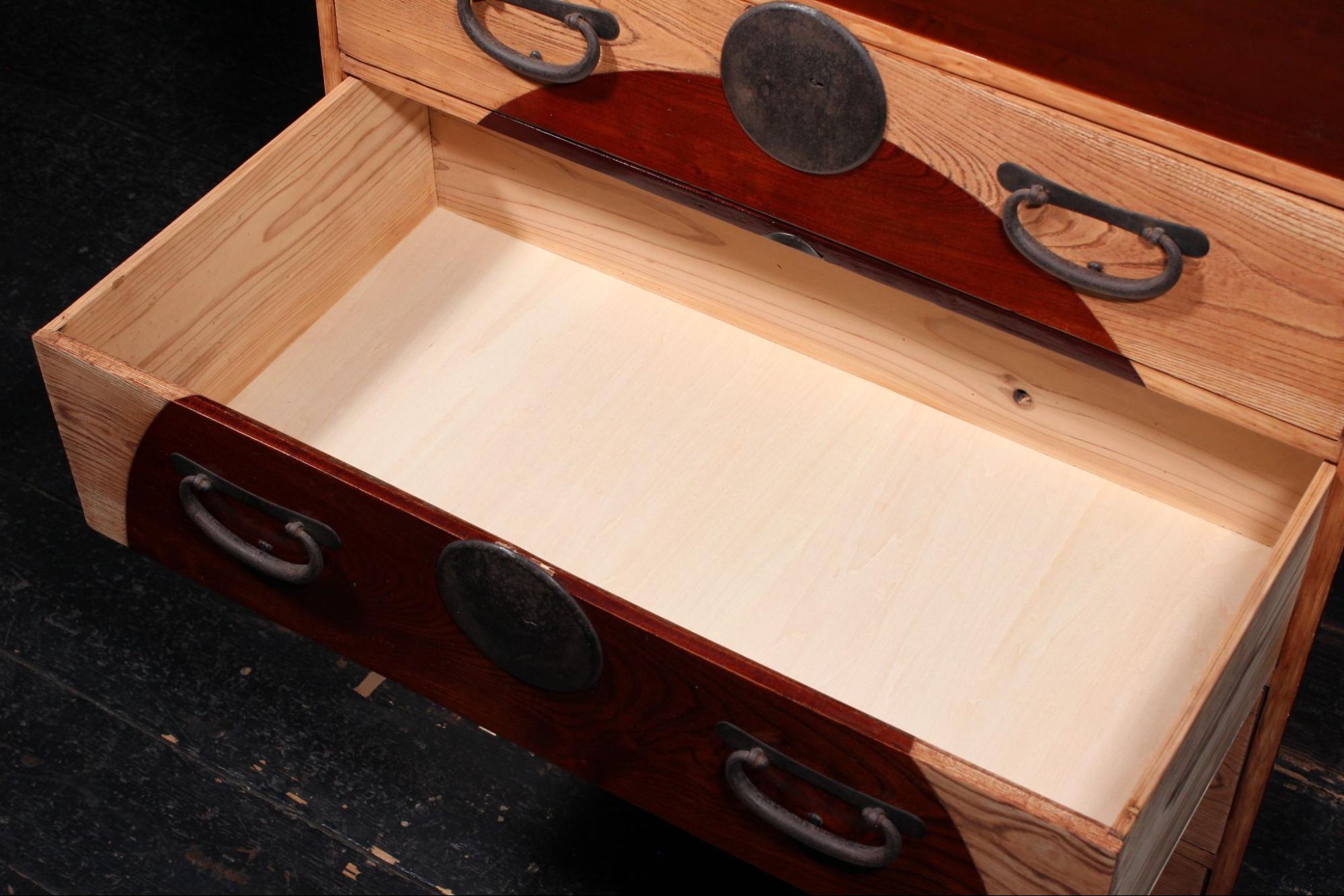
Also, if the condition is good and there is not much odor during the inspection at the time of repair, we polish all surfaces with the original material and then finish it after cleaning, as shown in the photo below.

As described above, we strive to make sure there are no unpleasant odors while utilizing the charm of antique furniture. However, please note in advance that there may be a slight odor of 1 to 3 depending on the furniture material, finish, and the environment of the installation location.
Because they are invisible and there are individual differences in how they are felt, it is difficult to convey them accurately, so we recommend that you check the actual product if you can come to our warehouse.
Installation Location of Furniture
Most of the furniture sold at our workshop uses solid wood.
Natural solid wood is cut from a log, becomes a piece of furniture, and even now, decades to over a hundred years later, it continues to breathe. Living materials have a very deep texture and are attractive, but at the same time, they also have delicate aspects.
Since there are cases where a large burden is placed depending on the environment where it is placed, caution is required when installing furniture. In particular, sudden changes in humidity and temperature are a heavy burden on furniture and lead to deformation and cracking of solid wood. If the degree of deformation increases, there is a risk of usage problems such as the movement of doors and drawers becoming stiff.
Therefore, we ask you to avoid installing the furniture in places such as direct sunlight, places where air conditioner wind hits directly, near stoves, or places with high humidity, so as to avoid burdening the furniture as much as possible.
